






Foam has been quietly taking over the mattress industry for decades. It was cheaper to produce, easier to shape, and simple to market. And by the time most people noticed something was wrong with their sleep, it was already in almost every bed being sold.
How We Got Here
For most of the twentieth century mattresses were built to last. They were two sided, flippable, and designed to be maintained over time. Then the industry moved to one sided construction. We covered why in an earlier article in this series, and the consequences of that decision for spinal alignment and mattress longevity are significant. But the move to one sided mattresses also opened the door to something else. If you weren’t going to flip a mattress, you needed to put the comfort layer on top and keep it there. And foam was cheap, mouldable, and easy to market.
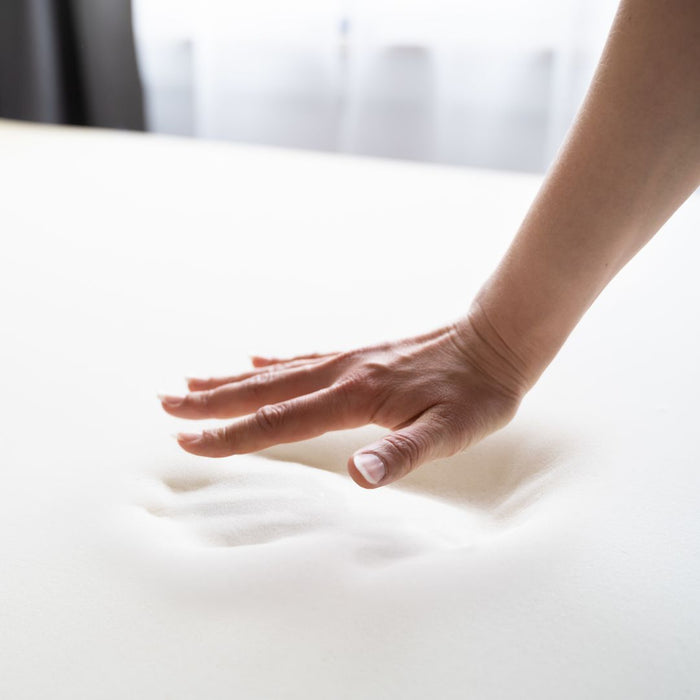
Memory foam in particular arrived with a story. Developed by NASA. Pressure relieving. Revolutionary. It responded to body heat and conformed to your shape. Showrooms loved it because customers could feel the difference immediately, pressing their hand into the surface and watching the imprint slowly disappear. What the showroom experience didn’t reveal was what happened over months and years of sleeping on it.
The Heat Problem and the Industry’s Answer
Memory foam sleeps warm. This became impossible to ignore as the material went mainstream. The same property that made it feel responsive, its sensitivity to body heat, also meant it absorbed and held warmth against the body through the night.
The industry’s answer was gel memory foam.
Gel beads or gel layers were added to the foam with the promise of a cooler sleep surface. And to be fair, gel foam does feel cooler to the touch when you first lie down. For about the first hour. Once the gel layer reaches body temperature it has nowhere to go. The cooling effect disappears and you’re left with the same heat retention problem.
Then came plant based foam. Soy foam. Green foam. Eco foam. These arrived with sustainability credentials and the implication that they were a fundamentally different material. Most of them contain somewhere between five and twenty percent plant derived content. The rest is petroleum. The thermal properties are essentially identical to conventional foam because the base material is essentially identical to conventional foam.
What Foam Is Actually Made Of
Every variation of foam, memory foam, gel foam, plant based foam, is built on a petrochemical foundation. Polyurethane is the base material. It’s derived from petroleum, it off-gasses volatile organic compounds, and it doesn’t breathe in any meaningful sense of the word.
This is the material most people are sleeping on for eight hours every night with their face inches away from it.
The off-gassing concern is real. New foam mattresses have a recognizable smell the industry calls off-gassing and recommends airing out before use. That smell is volatile organic compounds releasing from the material. Most of it dissipates relatively quickly. Some of it continues at lower levels for much longer.
The Certification That Certifies Itself
If you’ve shopped for a foam mattress recently you’ve likely seen the CertiPUR certification logo. It’s presented as a safety credential, a signal that the foam inside meets rigorous standards.
Here’s what’s worth knowing about CertiPUR. The program is administered by the Alliance for Flexible Polyurethane Foam, a trade organization whose board of directors is made up of foam producers. The foam industry created a certification program for foam, run by the foam industry, and that certification now appears on foam products as a consumer safety signal.
What CertiPUR actually certifies is that the foam meets a minimum threshold for VOC emissions and doesn’t contain certain already-banned substances. It certifies that the foam is less harmful than the worst versions. It does not certify that the foam is safe, natural, or comparable in any way to certified organic materials.
Certifications like GOLS, the Global Organic Latex Standard, and GOTS, the Global Organic Textile Standard, are a different category entirely. They independently certify what the material actually is, not simply that it cleared a minimum bar set by the industry producing it.
The Breakdown Nobody Talks About
Foam doesn’t just sleep warm. It collapses.
The body impression that forms in a foam mattress over time isn’t just a comfort issue. It’s the mattress permanently conforming to your sleeping position and holding you there every night. The springs or support layers underneath may still be intact. The foam comfort layer on top has given up. And because most foam mattresses are one sided, there’s nowhere to go.
The environmental consequence of this cycle is significant. When that mattress gets replaced, it goes to the landfill. And it stays there for a very long time.
A conventional polyurethane foam mattress takes up to 1,000 years to fully decompose in a landfill. A natural latex mattress, made from rubber tree sap, biodegrades in approximately one to two years.
That is not a small difference. That is the difference between a material that returns to the earth and one that occupies space in it for longer than recorded human history.
The Natural Latex Difference
Natural latex is sometimes grouped with foam in consumer conversations because both are used as mattress comfort layers and both have a similar feel in a showroom.
They are not the same material.
Natural latex is tapped from rubber trees. It has an open cell structure that allows air to move through it rather than getting trapped. It doesn’t off-gas petrochemicals. It doesn’t collapse into body impressions the way foam does. It’s naturally resistant to dust mites and mold. It biodegrades when its useful life is over. And it doesn’t hold heat the way foam does because air can move through it rather than sitting against the skin.
Why This Matters Beyond Comfort
The foam conversation is easy to frame as a preference. Some people like foam, some don’t, and that’s a matter of taste.
But it’s not really a comfort conversation. It’s a material conversation, and materials have consequences that comfort preferences don’t capture. What you sleep on for eight hours a night, breathing the air immediately above it, with your body’s largest organ in contact with it, is a health variable and an environmental one.
That’s the honest version of how we got here. At Resthouse we’ve never built our sleep systems around foam. Not because of preference. Because of what the material actually does.
Written by Chris Manley
Founder of Resthouse Sleep