












RESTHOUSE SLEEP · EST. 2014 · SERIES: THE CORE SIX · ARTICLE 01 OF 06
Where it Began
If you've ever wondered why your mattress developed a permanent dip in the middle, why rotating it only made things worse, or why the mattress you paid good money for seemed to give up on you after three or four years. The answer traces back to one design decision made by the industry roughly twenty-five years ago.
They stopped building mattresses you could flip.
It sounds minor. But that single change set off a chain of consequences that the industry has been managing with marketing ever since. Consequences that are still playing out in bedrooms across the country every night.
After twenty-five years in the sleep industry, this is the conversation I find myself having more than any other. And it's one the major mattress brands would prefer you never had.
What Flipping Actually Did
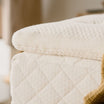
Beneath whatever fabric covers the surface, a mattress is a series of layers; support layers at the base, comfort layers on top. The comfort layers are the soft materials closest to your body: foam, wool, latex, cotton batting, or some combination. These are the materials that compress under your weight and shape themselves to your body over time.
When a mattress was designed to be flipped, those comfort layers existed on both sides. Every season, you flipped the mattress and the side that had been compressing under your body got to decompress and recover while you slept on the other side.
The result was a mattress that wore evenly, recovered consistently, and lasted. A quality flippable mattress, properly maintained, would serve a household for ten to fifteen years without significant body impressions forming. It was the design working as intended.
The materials in a well-made mattress have memory. They compress under load and want to return to their original state. Flipping gave them time to recover, free from the weight of your body, and it’s what kept the surface consistent and supportive over time.
Why the Industry Stopped
It was simply economics.
A two-sided mattress costs more to manufacture. Both surfaces need to be finished. The comfort layers need to be built into both sides. The mattress is heavier, which makes it more expensive to ship. And a mattress that lasts fifteen years is a mattress that gets replaced less often.
For the manufacturer, the shift to one-sided construction solved all of those problems at once. For the consumer, it created new ones.
A one-sided mattress is not half a mattress. But it does have half the usable surface of the design it replaced.
The comfort layers now existed only on the top. The bottom became a hard, unfinished base. Flipping it was impossible. You couldn't sleep on the bottom side because there was nothing there designed for sleeping on.
The industry's answer to the obvious question of "what do I do when the top wears out?" was rotation. Swap the head end and the foot end. This distributes wear across the length, which helps slightly, but does nothing to address the fundamental problem: there is only one sleep surface, compressing in one direction, under the same bodies, night after night, with no recovery period.
What Happens Without the Flip
Body impressions are what the industry calls the permanent compressions that form in a mattress surface over time. Every mattress develops them eventually. The problem lies in how quickly they form, how deep they get, and what options you have when they do.
On a one-sided mattress, the answers are: faster than they should, deeper than they need to, and none.
The compression cycle works like this:
- Your body heat softens the comfort materials during sleep, making them more susceptible to compression.
- Your weight, concentrated in the same areas night after night, compresses those softened materials.
- Without a recovery period, the materials compact progressively. Each night builds on the compression of the night before.
- Within two to four years on most mid-range one-sided mattresses, the impressions are visible and measurable, often an inch or more deep in the areas where you sleep.
- Rotation moves you to a different area of the same surface, and the impressions you've created stay.
Within three to four years on most mid-range one-sided mattresses, the impressions are visible, measurable, and permanent.
The Replacement Cycle is Not an Accident
The standard industry recommendation for mattress replacement is every seven to ten years. That recommendation is not based on the lifespan of a well-made mattress. It is based on the average lifespan of the product the industry now predominantly makes.
A quality flippable mattress, made from durable natural materials and maintained properly, can last fifteen to twenty years without the kind of degradation that affects sleep quality. The shift to one-sided construction effectively cut that lifespan in half, and the replacement recommendation followed the product, not the other way around.
The seven-to-ten year replacement cycle is a business model.
The foam-in-a-box mattress category that followed accelerated this further. Rolled, compressed foam mattresses are built from materials that degrade faster still, and the free return policy exists in part because the brands know the product's limitations. When the mattress stops performing, the return is the answer.
What happens to the returned mattress is a different conversation, one we cover in full in Article 06 of this series.
What a Better Design Looks Like
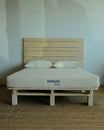
Flippable mattresses still exist. They are a simple design choice, and the right one for anyone who wants a sleep surface that will last and perform consistently over time.
At Resthouse, we carry flippable mattress options built from natural materials, organic wool, latex, cotton, specifically chosen because when they compress, they recover well over time. Natural materials behave differently than synthetic foam. They have a resilience that petroleum-based foam cannot replicate.
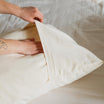
Beyond flippability, the other factor that changes the equation is the pillow. Our adjustable pillows, where fill can be added or removed to dial in exactly the right loft and feel for your body, address the fitting problem that no mattress can solve on its own. The right pillow, fitted to your shoulder width and sleep position, is as important as the surface beneath you.
These are not complicated ideas. They are old ideas, applied with better materials. The industry moved away from them because the economics pointed elsewhere. The consumers who understand what was lost are the ones who stop replacing mattresses every eight years.
What to Look For When You're Ready to Replace
Can this mattress be flipped? If the answer is no, ask why, and understand what that means for its lifespan.
What are the comfort layers made of? Natural materials, wool, latex, organic cotton, recover better than synthetic foam.
What is the realistic lifespan of this specific product, not the category average, but this mattress, in these conditions?
Is there a fitting process? A mattress chosen for your body, your weight, your sleep position, your partner's body, will perform better and last longer than one chosen by firmness alone.
Is the pillow part of the conversation? It should be.
These are not trick questions. A retailer or brand that knows their product will answer them directly.
Written by Chris Manley, Founder of Resthouse Sleep.