















Most people choose a pillow without much thought. They pick something that feels reasonable, bring it home, and live with the results. If it goes flat in a year, they replace it. If it causes neck pain, they try a different one.
This is not how a pillow should work. And once you understand what a properly fitted head pillow is actually doing, you’ll see why the replace-and-repeat approach was never going to get anyone anywhere.
I’ve been fitting pillows to people for thirty years. I’ve seen what works, what doesn’t, and why the standard approach leaves most people in a version of the same problem: a neck that doesn’t feel right in the morning, sleep that never quite hits the depth it should, and a growing acceptance that this is just how things are.
It isn’t.
The Job Your Pillow Isn't Built to Handle
Your head weighs between eight and twelve pounds. Every night, that weight settles onto a single surface, and the job of your pillow is to support it in a way that keeps your neck in neutral alignment with your spine.
That sounds simple. But most pillows can’t handle the job.
The right support height, density, and shape is different for every person. It depends on your shoulder width, your preferred sleep position, the firmness of your mattress, and the specific curve of your neck. A pillow that is perfect for one person is structurally wrong for the person sleeping next to them, in a way that creates real consequences over months and years.
The sleep industry has never seriously grappled with this. The standard approach is to offer pillows in a few firmness categories, soft, medium, firm, and let people sort themselves out. The neck pain most people blame on stress, posture, or aging is often the result of sleeping on a pillow that was never right for their body to begin with.
When someone comes to us after years of neck problems, we almost always find the same thing: they’ve been sleeping at the wrong height and the body has been compensating for the entire time.
The Slow Failure You Never Noticed
A conventional pillow is made of a fixed material, polyester fill, foam, or down, and it arrives at a certain height and density. From the first night you sleep on it, that changes.
The weight and heat of your head, applied nightly for months and years, compresses the fill. Polyester clumps and mats. Down shifts and packs. Foam breaks down. The pillow you bought at a specific loft is a different pillow within months, and a substantially different one within a year.
The problem is the materials. Most fill materials simply cannot hold their structure under years of nightly compression. The pillow starts right and gradually becomes wrong, and most people don’t notice the transition because it happens slowly. By the time the neck pain arrives, the pillow has been wrong for a long time.
The Free Return Isn’t Confidence
The online pillow industry figured out the same thing the mattress industry did: most people won’t return something they’ve slept on. It feels unhygienic. It feels like too much effort. So the free return policy isn’t a sign of confidence in the product. It’s a calculated bet that the barrier of personal use will do the work the pillow itself isn’t doing.
This is why you’ll find generous return windows on pillows that are fixed in height, fixed in density, and fixed in shape. There’s no mechanism inside the product to make it work for you. The return policy is the only safety net on offer, and the business model counts on you not using it.
A pillow that can be adjusted to your body doesn’t need that safety net. The fit isn’t a gamble you take at checkout. It’s something you establish yourself, in your own bed, on your first night home with it.
The Fill That Actually Doesn’t Compress
Organic rubber latex behaves differently than any other fill material used in pillows.
Latex is elastic at a molecular level. It compresses under pressure and returns to its original form when the pressure is removed. The same fill that supported your head last night will support it the same way tonight, and five years from now.
This is why a shredded latex pillow doesn’t go flat. The material doesn’t pack, mat, or break down under repeated compression. It recovers, completely, every time.
But the more important difference is its behaviour.
Shredded latex moves. Individual pieces shift and reorganize as you do, filling the specific contours of your head and neck in whatever position you find yourself in. You don’t have to find the right spot on the pillow. The pillow finds you.
A Pillow That Moves With You
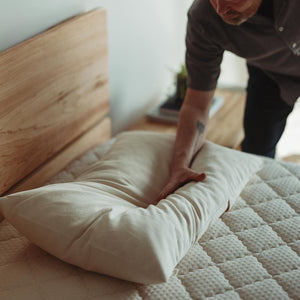
Because the fill is loose and responsive, you can shape the pillow actively, to exactly what your body needs. Not just adjust the loft before bed. Shape it while you’re in it, around you, in real time.
Side sleepers tend to build a bolster effect, gathering fill toward the neck to create height under the cervical spine while letting the area under the ear stay a little softer. The pillow supports the neck where the neck needs it, without forcing the head up or letting it sink.
Back sleepers nest. They press the centre down slightly and let the fill rise around the edges, cradling the head with gentle walls of support on either side and keeping the neck in a neutral, open position through the night.
This matters more than it might seem. A pillow that’s the right height for side sleeping is almost always too high for back sleeping. When a fixed pillow pushes the head forward, the chin drops toward the chest, the throat narrows, and the airway compresses. This is a direct contributor to snoring and disrupted breathing during sleep, and most people have no idea their pillow is causing it.
When you press the centre of a shredded latex pillow down and let your head settle back into it, the neck stays long. The airway stays open. The head isn’t being propped forward into a position the body has to compensate for. It’s resting where it actually wants to be.
That’s the difference between a pillow that holds you at a fixed height and one that responds to the position you’re actually in.
And then there’s the face tuck. When you pull a shredded latex pillow in close and tuck the edge of it under your chin, it comes up slightly against your cheeks, covers the sides of your face, and holds the whole head rather than just supporting the back of it. Your head doesn’t roll, it’s securely held, from underneath and from both sides, in a position that stays stable through the night.
“I can tuck it underneath my chin and it covers my cheeks. There’s something about that held feeling that lets the rest of me go.”
Chris Manley, Founder of Resthouse Sleep
But here’s what’s worth understanding about all of that movement and adaptability: Your body shifts constantly through the night, and the shredded latex shifts with it. That’s a genuine advantage over any fixed pillow.
Fitting, Not Just Buying
Resthouse pillows arrive intentionally overstuffed.
The fill is set higher than almost anyone will want it, because the fitting process starts from too much and works down. Fill is removed in increments, and you test height and feel at each stage until the pillow is right for your body, your mattress, and your position. This is fundamentally different from choosing between soft, medium, and firm on a tag. It’s a fitting.
And it means you can buy this pillow online without the anxiety that comes with every other pillow purchase. You don’t need to get it right at checkout. You get it right at home, in your own bed, on your first night with it. Just open the zippered encasement and adjust the fill until it’s yours.
Most online pillow companies offer free returns because the product is a fixed object and the fit is a gamble. The return policy is the safety net for a pillow that may never work for you. An adjustable pillow doesn’t need that net. It is tailored to you and your body, from the first night.
The result is a pillow calibrated to you specifically. To the actual height your neck needs, with the actual density your head wants to settle into. And because the fill is adjustable, the pillow can change with you. Through a mattress swap, a change in sleep position, a shift in what feels right over time.
What This Means for Your Sleep
Most people who find their way to a properly fitted shredded latex pillow say a version of the same thing: they didn’t realize how much effort they had been putting into their pillow until they stopped having to.
The searching for the right spot. The flipping and repositioning. The waking up and finding the pillow halfway across the bed. Those are signs of a pillow that isn’t working. When a pillow is working, you settle in, the fill moves around you, and you don’t think about it again until morning.
That’s what we’re trying to give people.
We watched the replace-and-repeat cycle play out for years. People coming in with their third pillow in four years, still not sleeping well, starting to believe the problem was them. Really the problem was an industry that never asked whether a fixed object could fit an endlessly variable one. We decided to ask that question, and the answer was a single adjustable pillow that could become the right pillow for anyone willing to spend fifteen minutes finding their fit. Thirty years in, we’ve never found a reason to go back to the other approach.
If you want to experience what a fitted shredded latex pillow actually feels like, come in for a complimentary sleep consultation. We’ll fit it to your body, show you how to adjust it at home, and send you out with something that was made for you specifically. Or order online and do the fitting yourself. Either way, you can’t get it wrong.
That’s how a pillow should work.